
Share This Article
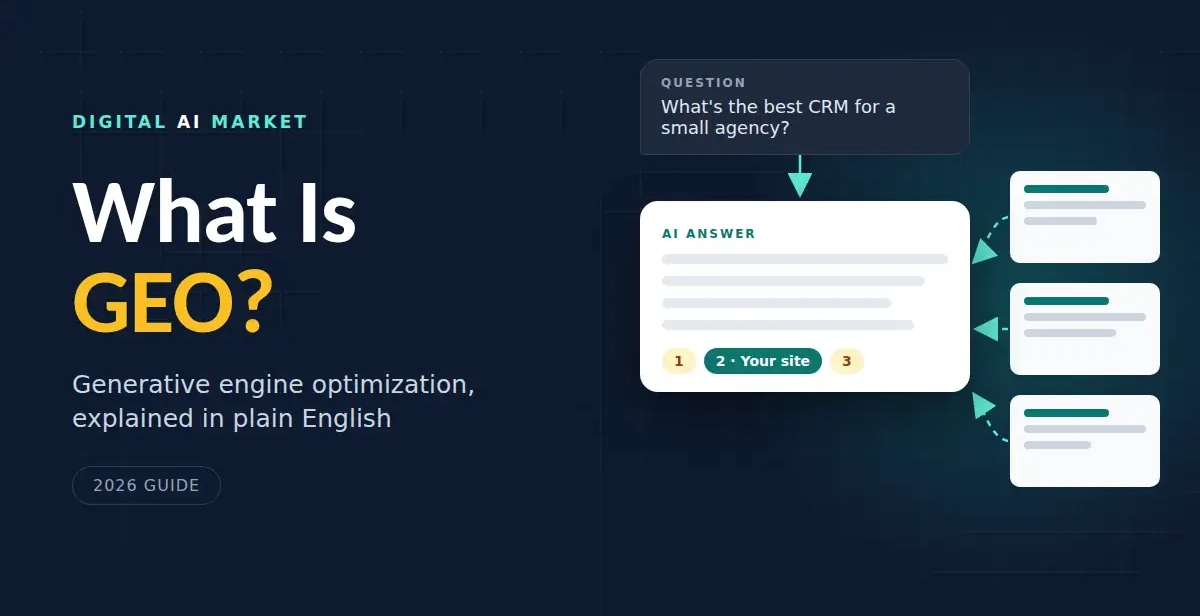
Generative engine optimization (GEO) is the work of making your content easy for AI search tools such as ChatGPT, Perplexity, Gemini, Copilot and Google’s AI Overviews to find, trust and cite when they write an answer. It builds on SEO rather than replacing it: the page still has to be crawlable, indexed and genuinely useful. What changes is the goal. You are trying to become one of the few sources an AI names in its answer, not just one of ten blue links.
That’s the short version. The longer version is more interesting, because a lot of what gets sold as “GEO” in 2026 is guesswork, and some of it is advice the search engines themselves have told you to ignore.
This guide covers where the term came from, how AI search tools actually choose sources, what Google has said on the record, and a practical plan a small site can follow without buying anything.
Key takeaways
- GEO means optimizing to be cited inside AI-generated answers, not only to rank in a list of links.
- The term comes from a 2023 research paper (published at KDD 2024) that found adding quotations, statistics and source citations made content noticeably more visible in AI answers, while keyword stuffing made it worse.
- Google’s May 2026 guidance says optimizing for its AI features is still SEO, and names tactics you can skip, including llms.txt files and chopping content into small chunks.
- ChatGPT, Perplexity, Claude and Copilot each use their own crawlers or search partners, so being crawlable by the right bots matters more than any special markup.
- You can now measure some of this for free: Search Console, GA4 and Bing Webmaster Tools all added AI reporting in 2026.
Where the term “GEO” came from
The phrase “generative engine optimization” was coined by researchers from Princeton, Georgia Tech, the Allen Institute for AI and IIT Delhi in a paper titled GEO: Generative Engine Optimization, first posted in late 2023 and presented at the KDD 2024 conference.
The team built a benchmark of 10,000 queries and tested how small changes to a web page affected how much of that page showed up in an AI-generated answer. A few results are worth knowing:
- Adding relevant quotations, statistics and citations to credible sources gave the biggest lifts. The best methods improved visibility by up to about 40% on their test setup.
- Keyword stuffing performed worse than doing nothing. Generative engines read for meaning, so repeating a phrase doesn’t help.
- Results varied by subject. What worked for history questions didn’t always work for law or science questions.
- When they repeated the tests on Perplexity, a real product, the improvements held up (up to around 37%).
Two caveats before you treat these numbers as gospel. The experiments ran on 2023-era models, and the AI tools people use today are far more capable. And “visibility” in the paper means how much of your text appears in the answer, which isn’t the same thing as clicks or sales. The direction of the findings still makes sense, though: AI systems favour content that is specific, well-sourced and easy to quote.
GEO vs SEO vs AEO: are they actually different?
You’ll see three acronyms used almost interchangeably. Here’s how they relate.
| SEO | AEO | GEO | |
|---|---|---|---|
| Stands for | Search engine optimization | Answer engine optimization | Generative engine optimization |
| Main goal | Rank pages in search results and earn clicks | Be the direct answer (featured snippets, voice, AI answers) | Be cited or summarized inside AI-written answers |
| Where it shows up | Google, Bing organic results | Featured snippets, “People also ask”, voice assistants, AI answers | ChatGPT, Perplexity, Gemini, Claude, Copilot, Google AI Overviews and AI Mode |
| What success looks like | Rankings, clicks, traffic | Your wording used as the answer | Your brand or page named as a source |
| Still needs crawlable, indexed, useful pages? | Yes | Yes | Yes |
Google’s own view is blunt. In its guide to optimizing for generative AI features, published in May 2026, it treats AEO and GEO as labels for the same job and says optimizing for generative AI search is “still SEO.” For Google’s products, that’s the right way to think about it: AI Overviews and AI Mode are built on top of Google’s normal index and ranking systems.
The picture is less tidy outside Google. ChatGPT search, Perplexity and Claude run their own crawlers and retrieval systems, and Microsoft Copilot leans on Bing. So a page that ranks well on Google isn’t automatically the page those tools cite. In practice, most of the work overlaps, but GEO adds a few extra checks, which we cover below.
For a closer look at Google’s two AI features, see our guide to Google AI Mode vs AI Overviews.
How AI search tools choose which sources to cite
Most AI search products follow the same basic pattern, even if the details differ.
1. They break your question into several searches. Google calls this query fan-out. Ask “what’s the best CRM for a five-person agency?” and the system might quietly search for CRM pricing for small teams, CRMs with client portals, agency CRM reviews, and so on.
2. They retrieve pages from an index. Google uses its Search index. ChatGPT, Perplexity and Claude use their own search crawlers and partners. If a page isn’t in the index a tool draws from, it can’t be cited, however good it is.
3. They read the retrieved pages and write an answer. This is called retrieval-augmented generation (RAG). The model pulls specific facts or passages from the pages it retrieved and writes a response, usually with links to the sources it relied on.
This explains most of what works in GEO. You need to be retrievable (crawlable and indexed), relevant to the sub-questions the system generates (not just the headline keyword), and easy to quote (clear, specific, backed by evidence).
It also explains why the sources AI tools cite often differ from Google’s top ten. The fan-out searches are different from the query the person typed, and each tool uses a different index. Industry studies disagree on exactly how big that gap is, so be wary of anyone quoting a single precise figure.
What Google says you can ignore
Google’s May 2026 guide is unusually direct about popular tactics that don’t help with its AI features. According to the guide:
- llms.txt and similar “AI files” aren’t needed. Google Search doesn’t use them; they neither help nor hurt. (We look at whether other platforms use them in our llms.txt explainer.)
- You don’t need to chunk content into tiny pieces. Google’s systems can understand long pages that cover several subtopics.
- You don’t need special “AI rewrites”. Write naturally; the systems understand synonyms and meaning.
- Chasing inauthentic mentions doesn’t work. Planting your brand name across forums and low-quality sites won’t improve visibility.
- Structured data isn’t required for AI features. It still helps you qualify for rich results, but there’s no special schema for AI Overviews. Our schema guide covers what’s still worth adding.
The guide also warns that creating lots of near-duplicate pages to target every fan-out variation can count as scaled content abuse under Google’s spam policies. In other words: don’t build a thousand thin pages hoping one gets cited.
A practical GEO framework (8 steps)
Here’s the approach we’re using for Digital AI Market. None of it needs a paid tool.
1. Let the right crawlers in
This is the most overlooked step. AI search tools can only cite pages their crawlers can reach, and each company runs separate bots for search and for training. Blocking the wrong one can quietly remove you from an AI tool’s answers.
| Company | Bot that affects search / citations | Bot used for model training | Notes |
|---|---|---|---|
| Googlebot (normal Search crawling) | Google-Extended (a control token, not a separate crawler) | Google says Google-Extended doesn’t affect inclusion or ranking in Google Search. AI Overviews and AI Mode use the regular Search index. | |
| OpenAI | OAI-SearchBot | GPTBot | OpenAI says sites that block OAI-SearchBot won’t appear in ChatGPT search answers. |
| Anthropic | Claude-SearchBot (and Claude-User for user requests) | ClaudeBot | Anthropic says blocking Claude-SearchBot reduces your visibility in Claude’s search results. |
| Perplexity | PerplexityBot | Not used for training, per Perplexity | Perplexity also asks sites to allow its published IP ranges, which matters if you use a firewall. |
| Microsoft | Bingbot | — | Copilot answers draw on Bing, so Bing indexing matters. |
Whether you allow the training bots is a separate business decision. Blocking GPTBot or ClaudeBot doesn’t remove you from ChatGPT or Claude search results, as long as the search bots are allowed. Check your robots.txt, and ask your host whether a firewall or bot-protection setting is blocking any of these. It happens more often than you’d think.
2. Get indexed in both Google and Bing
Submit your XML sitemap in Google Search Console and Bing Webmaster Tools. On WordPress, add IndexNow (most SEO plugins support it) so Bing hears about new and updated pages quickly. Bing’s own guidance to publishers recommends IndexNow specifically so AI answers pick up your latest version.
3. Publish content an AI can’t write by itself
Google’s guide keeps returning to one idea: non-commodity content. If an AI could produce your article by summarizing the top five results, there’s no reason for it to cite you. What earns citations is information that only you have:
- results from something you actually tested
- your own data, screenshots or numbers
- a clear, reasoned opinion from someone with real experience
- local, current or niche detail the big sites skip
We go deeper on this in what Google means by non-commodity content.
4. Answer the question early, then go deeper
AI systems lift passages, so make your best passage easy to find. Start each important section with a direct one- or two-sentence answer, then explain the detail, exceptions and examples. Use headings that match how people actually ask (for example “How much does X cost?” rather than “Pricing considerations”).
This isn’t the same as chunking content for machines. It’s just good writing: a busy reader wants the answer first, too. Our answer engine optimization guide shows before-and-after rewrites.
5. Back up your claims
This is where the original GEO research and Bing’s publisher guidance agree. Specific numbers, named sources and short quotes from real experts make a page more citable. Vague claims (“studies show…”) make it less so.
A few habits that help:
- Link to the primary source (the official documentation, the study itself), not a blog that summarized it.
- Say when a number was measured and by whom.
- If data is disputed, say so. Being honest about uncertainty is part of being trustworthy.
6. Cover the whole topic, not one keyword
Because AI tools fan a question out into several searches, a single article rarely answers everything. Build a cluster: one pillar page (like this one) plus supporting articles that each answer a specific sub-question in depth, all linked to each other. It helps readers, it helps Google understand your expertise, and it gives AI tools more chances to find a relevant page from your site.
7. Keep pages fresh and consistent
Show a visible “last updated” date and actually update the page when facts change. Bing’s guidance names freshness directly, and AI tools that cite outdated prices or product names do no favours to anyone. Also make sure the facts about your brand, products and people match everywhere: your site, your social profiles, your Google Business Profile.
8. Earn real mentions
AI tools learn which sources are trusted partly from what the rest of the web says. Real reviews, genuine community discussion, guest contributions and press coverage all help. Paid or fake mentions don’t, and Google says so explicitly.
How to measure GEO in 2026
A year ago, measuring AI visibility meant guesswork. Now there are several free reports, each with limits.
| Tool | What it shows | What it doesn’t |
|---|---|---|
| Google Search Console, Generative AI report | How often your pages appear as links in AI Overviews and AI Mode (impressions), by page, country and device | Clicks, queries or position. See our Search Console AI report guide. |
| GA4 “AI Assistant” channel | Visits that arrive from recognised AI assistants such as ChatGPT, Gemini and Claude | Visits from Google AI Overviews/AI Mode (counted as Organic Search), or AI visits without referrer data (often Direct). Not retroactive. See how to track AI traffic in GA4. |
| Bing Webmaster Tools, AI Performance | How often Copilot and Bing AI answers cite your pages, plus “grounding queries” (the searches the AI ran) | Anything outside Microsoft’s products. See our Bing AI Performance guide. |
| A manual prompt panel | Whether you’re named when you ask real questions in ChatGPT, Perplexity, Gemini, Claude and Copilot | Scale. Answers vary between runs, so check the same prompts monthly and look at trends. |
The manual panel is simple: write down 15–20 questions your ideal reader would ask, run them in each assistant once a month, and record whether your site is cited. It takes about an hour and tells you more than most paid dashboards at this stage. We explain the full method in why ranking first on Google doesn’t guarantee a ChatGPT citation.
Common GEO mistakes
- Blocking AI search crawlers by accident, usually through a security plugin, CDN bot setting or an over-broad robots.txt rule.
- Writing for machines instead of people. Lists of disconnected facts, forced FAQ sections and repeated keywords make a page worse for both.
- Relying on one headline statistic from a vendor study without checking how it was measured.
- Publishing and forgetting. AI tools prefer current information, and stale pages lose citations.
- Expecting instant results. A new site has to be crawled, indexed and trusted first. That takes months, not days.
A 30-day GEO starter plan for a small site
Week 1: foundations. Check robots.txt and firewall settings for the bots in the table above. Verify Search Console and Bing Webmaster Tools, submit sitemaps and turn on IndexNow. Set up GA4 and confirm the AI Assistant channel appears.
Week 2: trust signals. Publish or improve your About page, author bios (real names, real experience) and an editorial policy that explains how you check facts and how you use AI.
Week 3: your first cluster. Pick one topic you know well. Publish a pillar page and two or three supporting articles, each answering a specific question with first-hand detail. Link them together.
Week 4: measure and refine. Build your 15–20 question prompt panel and record a baseline. Check Search Console and Bing for early impressions. Update anything that’s already out of date.
Frequently asked questions
Is GEO replacing SEO?
No. For Google’s AI features, GEO is SEO: the same index and ranking systems decide which pages are used. For ChatGPT, Perplexity and Claude, good SEO still does most of the work, with extra attention on letting their crawlers in and writing content that’s easy to quote.
What is the difference between GEO and AEO?
They overlap heavily. AEO (answer engine optimization) grew out of featured snippets and voice search and focuses on being the answer. GEO focuses on being cited in AI-written answers that may draw on several sources. Most practical advice applies to both.
Do I need an llms.txt file for GEO?
Not for Google. Google’s May 2026 guide says its search systems don’t use llms.txt. It won’t hurt to have one, but it’s not a priority. Crawler access and content quality matter far more.
How long does GEO take to work?
For a new site, expect months. Pages need to be crawled, indexed and trusted before AI tools use them. Established sites with strong content can see changes faster, especially after updating existing pages.
Can I pay to appear in ChatGPT answers?
Not in the answers themselves. OpenAI now sells ads in ChatGPT in several countries, but they’re shown separately and labelled as sponsored. OpenAI says ads don’t influence ChatGPT’s answers.
How do I know if AI tools are citing my website?
Use Google Search Console’s Generative AI report for AI Overviews and AI Mode, Bing Webmaster Tools’ AI Performance report for Copilot, GA4’s AI Assistant channel for visits from chatbots, and a monthly manual check of your key questions in each assistant.
The bottom line
GEO is less mysterious than it’s often made to sound. AI search tools can only cite pages they can reach, understand and trust. Let their crawlers in, write things only you can write, back up what you say, and keep it current. That’s also a fair description of good SEO, which is exactly Google’s point.
New to the vocabulary? Our AI search glossary explains terms like query fan-out, grounding and RAG in plain English.
Sources
- Google Search Central, Optimizing your website for generative AI features on Google Search (May 2026)
- Google Search Central, AI features and your website
- Google Search Central, Google’s common crawlers (Google-Extended)
- Google Search Central Blog, Search generative AI performance reports
- Aggarwal et al., GEO: Generative Engine Optimization, KDD 2024
- OpenAI, Overview of OpenAI crawlers
- Anthropic, Does Anthropic crawl data from the web, and how can site owners block the crawler?
- Perplexity, Perplexity crawlers
- Bing Webmaster Blog, Introducing AI Performance in Bing Webmaster Tools
- Search Engine Journal, Google Analytics adds AI Assistant as default channel group